Friday, November 23, 2012

Tuesday, November 20, 2012
Literature Review # 5
(1)
(2) U.S. Senate. HEALTH, EDUCATION, LABOR AND
PENSIONS COMMITTEE. For Profit Higher
Education: The Failure to Safeguard the Federal Investment and Ensure Student
Success (1-181). Washington: Government Printing Office, July. 2012
(3) The US Senate's HELP committee researched
the deceptive tactics that for-profits used during their enrollment process.
Their results show that for-profits will go to extreme lengths to recruit
students, including targeting the most vulnerable parts of the population.
(4) The US HELP committee is a portion of the
Senate. It handles manners concerning the health, education, and work force of
the nation.
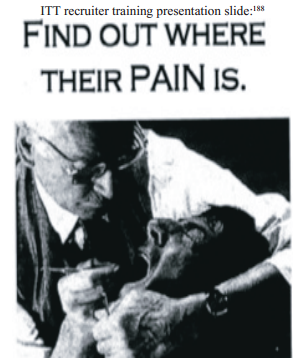
(5) Pain Funnel - sales tactic used by
for-profit recruiters that elicits pain in students, causing them to make decisions
without much thought
Objections - doubts or concerns students
may have about enrollment. Recruiters used scripts or aggressive language to
overcome student objections.
(6) "After a recruiter located a
prospective student’s pain point, the “pain funnel” presented a number
of
questions that the recruiter can ask that are progressively more hurtful"
(HELP 62).
Students
are mentally backed into a corner with the pain funnel method. Then, recruiters
would offer the solutions to all of the students' problems in the form of a
for-profit degree.
"For
instance, Vatterott’s internal “Student Profiles,” part of a manual to train recruiters,
detailed the demographic subgroups that the company targets for enrollment:
'Welfare Mom w/Kids. Pregnant Ladies. Recent Divorce. Low Self-Esteem. Low
Income Jobs. Experienced a Recent Death. Physically/Mentally Abused. Recent
Incarceration. Drug Rehabilitation. Dead-End Jobs-No Future'"(HELP 58).
Low-income
and minority populations are targeted by these companies, and recruiters are
trained to find and take advantage of students who fit the description.
"An
internal Concorde email indicates that company employees had visited 'welfare
offices' and 'unemployment offices,' although recruiters were later told to
stop visiting these offices because it may be a violation of accreditation
standards" (HELP 58).
In their
attempt to exploit low-income neighborhoods and find prospective students, some
recruiters have been known to show up at social service organization offering for-profit
education as solutions to vulnerable people.
(7) This study explicitly shows the methods
used by for-profit college in their efforts to take advantage of the low-income
communities. Students are pushed to the edge, emotionally, and then offered a
solution in for-profit education. If students do not comply, they are met with
more aggressive methods of recruitment.
Wednesday, November 7, 2012
Literature Review #4

(2) U.S. Congress. Government Accountability Office. FOR-PROFIT COLLEGES: Undercover Testing Finds Colleges Encouraged Fraud and Engaged in Deceptive and Questionable Marketing Practices. (1-27) Washington: Government Printing Office, Aug. 2010.
(3) The GAO conducts a study in which their agents visit 15 for-profit colleges in an effort to uncover the enrollment process of for-profit schooling.The study finds that for-profits use deceptive tactics to enroll students and also falsify student information to maximize their financial aid award.
(4) The GAO is part of the legislative branch of the US government. It serves to audit, evaluate, and investigate the use of public funds. The GAO makes reports in order to maximize efficiency in public spending.
(5) FAFSA - free application for federal student aid
Federal student aid - helps students pay for college with free grants, work study programs, and loan programs
.
Federal student aid - helps students pay for college with free grants, work study programs, and loan programs
.
(6) "Within a month of using the Web sites, one student interested in business management received 182 phone calls and another student also interested in business management received 179 phone calls" (14).
As soon as students sign up for websites affiliated with for-profits, they are immediately targeted, receiving calls from unrelenting recruiters.
"Three colleges required undercover applicants to make $20–$150 monthly payments once enrolled, despite the fact that students are typically not required to repay loans until after the student finishes or drops out of the program"(13).
For-profit recruiters would use deceptive tactics to persuade students to pay fees, which sometimes did not even exist.
"At the same Florida college, multiple representatives used high pressure marketing techniques, becoming argumentative, and scolding our undercover applicants for refusing to enroll before speaking with financial aid" (12).
Students are pressured to enroll in for-profits and if they are not complying, recruiters would often become aggressive.
As soon as students sign up for websites affiliated with for-profits, they are immediately targeted, receiving calls from unrelenting recruiters.
"Three colleges required undercover applicants to make $20–$150 monthly payments once enrolled, despite the fact that students are typically not required to repay loans until after the student finishes or drops out of the program"(13).
For-profit recruiters would use deceptive tactics to persuade students to pay fees, which sometimes did not even exist.
"At the same Florida college, multiple representatives used high pressure marketing techniques, becoming argumentative, and scolding our undercover applicants for refusing to enroll before speaking with financial aid" (12).
Students are pressured to enroll in for-profits and if they are not complying, recruiters would often become aggressive.
(7) This study shows the harshness of the for-profit recruitment process. Students, such as those in the minority population, are easily taken advantage of by these schools. Desperate for an opportunity for schooling, students are often misled into paying more for education, enrolling into for-profit schooling without taking the time to research the educational institution.
Friday, November 2, 2012
BLOG POST #7 : Argument & Counter-Argument
In
my paper, I argue that low-income students will find more benefit in enrolling
in community colleges or traditional schooling, rather than enrolling in
for-profit colleges. One counter-argument supports the rise of for-profit
colleges and learning activities provided within the institutions. Occupational
colleges focus on providing students hands-on learning classes that helps the
students gain major experience in their relative field. Career services building
are major offices in most for-profit schools, emphasizing the institution's
desire to help their graduates, including many disadvantaged students, acquire
and maintain a career.
Monday, October 22, 2012
Literature Review Blog # 3

(1)
(2) U.S.
Congress. Government Accountability Office. Postsecondary
Education: Student Outcomes Vary at For-Profit, Nonprofit, and Public Schools.
(1-19) Washington: Government Printing Office, 2011.
(GAO)
conducted two studies that assess the quality of education in proprietary
colleges and traditional universities. Studies showed that for-profits schools
had higher graduation rates for certificate programs, similar graduation rates
for associate's degree programs, and lower graduation rates for bachelor's
degree programs than students at traditional schools.
(4) The
GAO is part of the legislative branch of the US government. It serves to audit,
evaluate, and investigate the use of public funds. The GAO makes reports in
order to maximize efficiency in public spending.
(5)
"Beginning Postsecondary Students (BPS) Longitudinal Study" - survey of beginning students at three
points in time: at the end of their first year, and then three and six years
after first starting in postsecondary education.
"
Education’s Integrated Postsecondary Education Data System (IPEDS) " - captures detailed enrollment data from all
schools participating in federal student aid programs.
(6) "An ongoing study suggests that students who started at for-profit schools had similar annual earnings, but higher rates of unemployment compared to students who started at nonprofit and public schools" (GAO 6).
Graduates of proprietary colleges seem to be less able to maintain a career in their relative majors.
"One ongoing study shows that for-profit schools had a higher proportion of students default on their student loans than 4-year nonprofit schools and 2-year nonprofit and public schools" (GAO 6-7)
The high cost of for-profit education causes more students to have trouble paying off student loans, when compared to traditional universities.
"Available data indicate that for-profit schools enroll a higher proportion of low-income, minority, and nontraditional students who face challenges that can affect their educational outcomes. Students with
these characteristics tend to have less positive educational outcomes than other students" (GAO 2-3).
Low-income, and minority students have lower chances of becoming successful when enrolling in for-profit education.
It seems that for-profit institutions are taking advantage of the low-income and minority population. Those that enroll in proprietary education may not be as successful as they could be. The studies show that minorities will not be able to find employment as easily, nor will they be able to relieve themselves of student debt.
(6) "An ongoing study suggests that students who started at for-profit schools had similar annual earnings, but higher rates of unemployment compared to students who started at nonprofit and public schools" (GAO 6).
Graduates of proprietary colleges seem to be less able to maintain a career in their relative majors.
"One ongoing study shows that for-profit schools had a higher proportion of students default on their student loans than 4-year nonprofit schools and 2-year nonprofit and public schools" (GAO 6-7)
The high cost of for-profit education causes more students to have trouble paying off student loans, when compared to traditional universities.
"Available data indicate that for-profit schools enroll a higher proportion of low-income, minority, and nontraditional students who face challenges that can affect their educational outcomes. Students with
these characteristics tend to have less positive educational outcomes than other students" (GAO 2-3).
Low-income, and minority students have lower chances of becoming successful when enrolling in for-profit education.
It seems that for-profit institutions are taking advantage of the low-income and minority population. Those that enroll in proprietary education may not be as successful as they could be. The studies show that minorities will not be able to find employment as easily, nor will they be able to relieve themselves of student debt.
BLOG POST #6 : Case Study
One important case study that I' d like to explore researches graduation rates, employment outcomes, student loan debts, and default rates for students at for-profit schools in comparison to those at nonprofit and public schools. For me, this was a great starting point. It was more like a large overview of the student population, instead of a more direct look at the students within inner city communities. The study, conducted by the Congress' Government Accountability Office in 2011, also explores pass rates on licensing exams for selected occupations among graduates of for-profit, nonprofit, and public schools. The study showed that students enrolled in nonprofit and public institutions were usually more successful that those enrolled in proprietary education institutions.
U.S. Congress. Government Accountability
Office. Postsecondary Education:
Student Outcomes Vary at For-Profit, Nonprofit, and Public Schools. (1-19) Washington:
Government Printing Office, 2011 <http://www.gao.gov/assets/590/586738.pdf>
Monday, October 15, 2012
Literature Review Blog #2

(2)
Giroux, Henry A. "Neoliberalism,
Corporate Culture, and the Promise of Higher Education: The University as a
Democratic Public Sphere." Harvard
Educational Review Vol. 72
No. 4 (2002): 426-463. Print
(3) In this article, Henry
Giroux describes the negative effects that privatization has on faculty and
student of higher education. He argues that increased privatization will
produce selfish individuals and blur people's perspective of higher education.
(4) Henry
Giroux is an American cultural critic and one of the founding theorist s of
critical pedagogy in the United States. Giroux has written more than 40 book,
published almost 300 papers and has won many awards for his work.
(5) Neoliberalism - processes whereby a relative handful of private interests are permitted to control as much aspects of social life as possible to maximize profit.
Consumer - person who buys products or services
(5) Neoliberalism - processes whereby a relative handful of private interests are permitted to control as much aspects of social life as possible to maximize profit.
Consumer - person who buys products or services
(6) "Given the huge debt such students accumulate, it is reasonable to assume, as Jeff Williams points out, that loans effectively indenture students for ten to twenty years after graduation and intractably reduce their career choices" (Giroux 445).
High loan balances will force
college graduates to become employed earlier, searching for the easier career
opportunities, rather than then those they are actually interested in.
"The
message to students is clear: customer satisfaction is offered as a surrogate
for learning, and to be a citizen is to be a consumer, and nothing more.
Freedom means freedom to purchase” (Giroux 446).
Privatization
in the school system make learning seems like a business to students. Outside
the classroom, students are taught to buy products to gain satisfaction.
"A
class-specific divide begins to appear in which poor and marginalized
students will get low-cost, low-skilled knowledge and second-rate degrees from
online sources, while those students being educated for leadership positions in
the elite schools will be versed in personal and socially interactive
pedagogies in which high-powered knowledge, ... coupled with a high-status
degree" (Giroux 448).
When
business values replace the importance of critical learning, those who
cannot afford the best education will receive sub-par education.
(7) The more important aspects of this article pints out the influences that privatization has on student psychology. Students thought processes are being altered so that they are more likely to expect quick services for their investments, whether it be with products at a university store or education at the institution.
(7) The more important aspects of this article pints out the influences that privatization has on student psychology. Students thought processes are being altered so that they are more likely to expect quick services for their investments, whether it be with products at a university store or education at the institution.
Subscribe to:
Posts (Atom)